In most online shops we look at, the chat window is a contact form in disguise. A customer asks at 9.40 pm whether the jacket runs small, gets "we will reply within 24 hours", and buys somewhere else. By the time the answer arrives the next morning, the basket is gone.
The problem has two layers. The first is lost sales: a question asked before the purchase is a buying signal, and it expires within minutes. The second is wasted time: the same questions about delivery, returns and "where is my order?" fill the support team's day. Classic chatbots built on decision trees fix neither, because customers do not ask questions in the order the tree expects.
What is Zipchat?
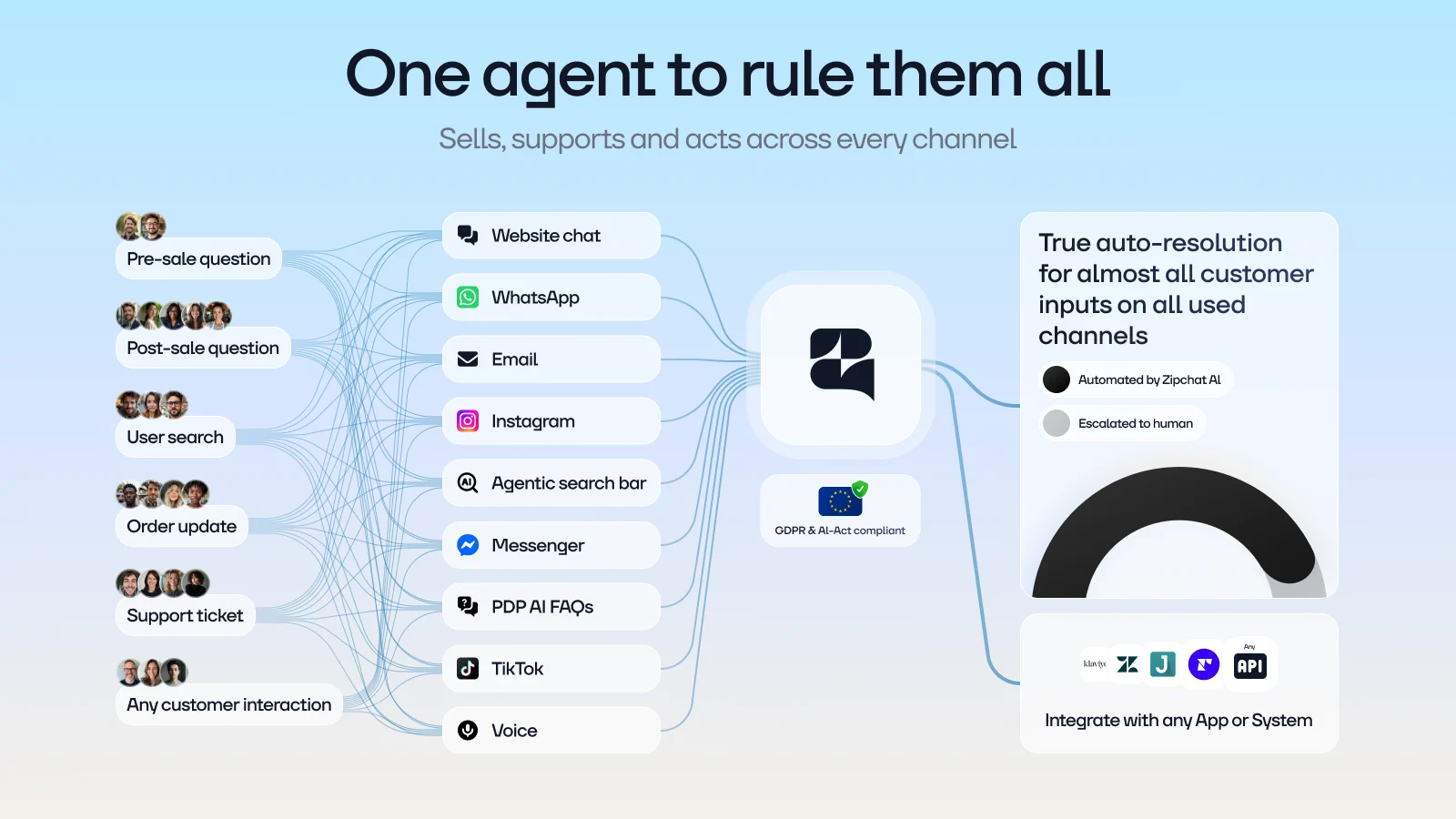
Zipchat is an AI agent for ecommerce. It learns your catalogue, your policies and your order data, then answers customers in their own language, recommends products and carries out simple tasks for them. It works in the website chat, on product pages, by email, and in WhatsApp, Instagram and Messenger.
According to the vendor, more than 2,500 ecommerce brands use it; the names shown on its site include Jackery, Euronics, Piquadro and BMW Motorrad. The app is rated 4.9 in the Shopify App Store and 4.8 on G2.
What sets Zipchat apart?
1. It sells, not only supports
This is the part that changes the maths. The vendor reports that 89% of conversations take place before the purchase, and that chats convert to a sale at 16.4% on average, against 2 to 3% for a typical shop visit. These are Zipchat's own figures, so treat them as a direction, not a promise. The mechanism is sound, though: the agent recommends products from your catalogue, answers the question that blocks the order and can start the conversation itself when a visitor hesitates.
2. An agent that acts, not only answers
Zipchat calls these Agentic Skills. The agent connects to your other systems through an API, a webhook or MCP and does the work: it takes a cash-on-delivery order, checks a parcel, opens a return. Order-status questions are handled without a person. Refunds wait for a human to approve them.
3. One agent on every channel, in any language
The same agent, with the same knowledge, answers in the website widget, by email, on WhatsApp and in Instagram and Messenger DMs. It detects the customer's language from the first message. For a Polish shop that sells to Germany or Czechia, that means support in a new market without hiring a native speaker on day one.
4. Connections to the tools you already use
Zipchat plugs into Shopify, WooCommerce, PrestaShop, Magento and BigCommerce, with an Admin API route for custom shops. On the support side it works with Zendesk, Gorgias, Intercom and Freshdesk, and it connects to HubSpot, Klaviyo and Zapier. From Zapier it is a short step to monday.com or any other system your team runs on.
5. Control instead of a black box
When the agent cannot help, it hands the conversation to a person together with the full context; the vendor says fewer than 3.2% of conversations end that way. Questions it could not answer land in a knowledge-gap queue, so you see what is missing from your content. Sales are attributed to conversations, so you can check whether the tool pays for itself. The vendor declares compliance with GDPR and the EU AI Act.
What does it cost?
Zipchat charges for AI replies, not for seats: every plan includes unlimited team members, all channels and all languages. Prices with annual billing, as of November 2026:
- Starter – 64 USD a month (80 USD billed monthly), 750 AI replies, roughly 300 conversations, 1 agent.
- Pro – 240 USD a month, 3,000 AI replies, 3 agents, priority support.
- Scale – 480 USD a month, 6,000 AI replies, 5 agents.
- Scale Plus – 960 USD a month, 14,000 AI replies, 10 agents.
- Unlimited – individual pricing from 2,100 USD a month, unlimited replies, price fixed for 12 months.
Every plan starts with a 7-day free trial and comes with a 30-day money-back guarantee. Before you pick a plan, count how many conversations your shop has in a month; that number decides the cost, not the size of your team.
Zipchat, or the chatbot in your helpdesk?
If you already run Zendesk or Gorgias and customers mostly write after the purchase, the bot built into your helpdesk is probably enough. If your catalogue is small and one FAQ page answers everything, you do not need an agent at all. Zipchat earns its place where customers ask before they buy (size, compatibility, delivery time), where a large share of traffic comes in the evening and at weekends, and where you sell in more than one language. It does not replace the helpdesk; it sits in front of it and passes on what needs a person.
Velg's view
We do not recommend tools because they are fashionable, only because they solve a specific problem. Zipchat makes sense when:
- customers ask questions before buying and nobody answers them within a few minutes,
- the support team spends its day on order status, returns and delivery questions,
- you sell abroad, or plan to, and cannot staff every language.
It does not make sense when your product data and policies are a mess. The agent answers from what you give it: incomplete descriptions, three versions of the returns policy and stock levels that live in a spreadsheet produce confident wrong answers. That is why we start with the data and the process, and add the agent second. It also will not pay back in a shop with a few dozen conversations a month; a person handles those faster than a rollout.
Transparency note: Velg is a Zipchat partner and the links to Zipchat in this article are referral links. If you sign up through them, we may earn a commission. It does not change what we recommend, or when we advise against it.
Is your shop still answering yesterday's questions this morning? Try Zipchat free for 7 days, or write to us at hello@velg.io and we will show you what the agent could do with your catalogue.