In our series of articles on the Velg blog we have already covered open-source project management (Plane.so), operational all-rounders (monday.com) and automated analytics (Databox). Today we go one level down, to where the structure of every business is born. Let's talk about data.
Most companies start the same way: with a sheet in Google Sheets or Excel. Soon the sheet is bursting at the seams, formulas break, and the lack of relations between tables breeds chaos. Moving to Airtable looks like the natural step. But what do you do when Airtable's price list makes your head spin, and your company's privacy policy (or the EU's GDPR) flatly forbids sending sensitive customer data to external, closed servers in the US?
The answer is Baserow.io, an open-source, remarkably fast no-code platform that redefines what a flexible database can be.
What is Baserow?
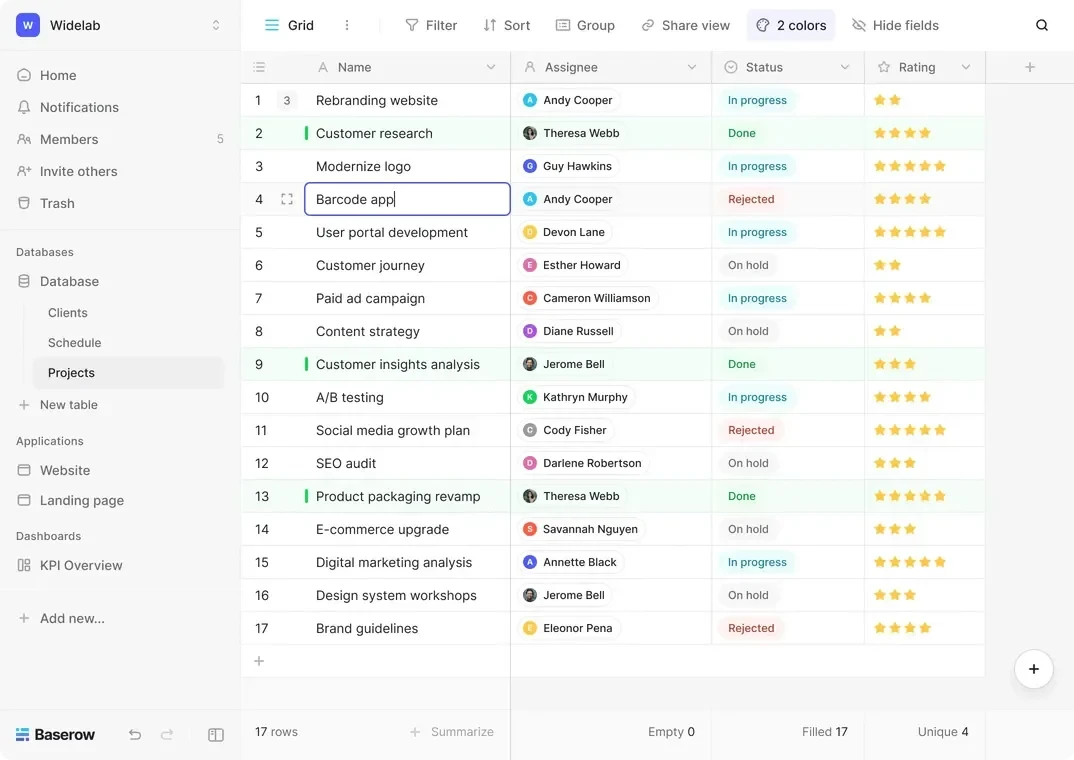
In the simplest terms: Baserow is an alternative to Airtable that you can run on your own server. It combines the simplicity and intuitiveness of a spreadsheet with the power and architecture of a professional relational database (PostgreSQL and Django run under the hood).
It is a bridge tool: it builds a bridge between non-technical managers and marketers (who want to click and see tidy tables) and the IT department and developers (who look warily at no-code tools without a proper API).
Why is Baserow winning over developers and business alike?
Baserow does not try to be just another clone of well-known products. From the start its makers bet on a few foundations that set it apart on the market:
1. API-first (a programmer's dream)
Many no-code tools treat the API as an extra. In Baserow it is the other way round. Every table you create automatically generates its own clear, ready-to-use API documentation (REST). This means Baserow can serve as a so-called headless CMS or as the backend for your mobile app or website. The non-technical team enters data in Baserow's clean panel, and your application fetches it through the API in milliseconds.
2. Uncompromising self-hosting and GDPR
For companies operating in Europe, data sovereignty is a key issue. You can run Baserow locally or in a private cloud with a single Docker container. You then have 100% control over where your customers' data physically sits, which makes it easier to meet even the strictest legal requirements.
3. Performance that does not buckle at 100k rows
Anyone who has tried to process huge volumes of data in traditional no-code tools knows they can slow down drastically or block further imports because of rigid plan limits. Baserow was designed for scale. Thanks to an architecture based on PostgreSQL, it can process hundreds of thousands of rows with no visible loss of smoothness.
4. Application Builder
Baserow is no longer only about databases. The platform has a built-in module for creating complete web applications from the data you have collected. With no front-end knowledge you can click together an internal portal for employees, a helpdesk system or a knowledge base for customers.
Velg's view: the future belongs to open source and no-code
At Velg we follow the democratisation of technology closely. Baserow is a perfect example of what modern software should look like: it gives freedom of choice (cloud or your own server), does not lock the user into one vendor's ecosystem (vendor lock-in) and allows easy integration with any system through an advanced API.
Whether you are building an advanced CRM tailored to your company's unique processes or need a flexible back end for a new MVP, Baserow proves that managing relational databases can be simple, secure and free of hidden costs.